Sharks in the Time of Saviors by Kawai Strong Washburn. 2020
I picked up an advanced reader’s copy a few months ago since it was about Hawaii, seemed right up my alley. A trip in early 2020 to Japan meant I was only reading books about Japan so it sat collecting dust on the bookshelf despite its great cover.
Well hello covid and I wanted to read some fiction and saw it was getting some nice press. I don’t often read new books since the wait list is usually long at the library so it seemed a treat to read something that was published in March.
The book is a magical realism-lite story about a family from the Big Island who have to move to Oahu to try to make ends meet. The story alternates by having each chapter from all the family members.
It starts off with the young couple having a little alone time in the Waipi’o Valley while a relative babysits their first son Dean. They have an encounter with the Night Marchers (ghosts of ancient Hawaiian warriors) and get the heck out of there. 9 months later their second son Nainoa is born. When he is 7 he falls overboard into the ocean and sharks save him. That is when the family starts to think there is something special about him.
This book did not go in the direction I thought it would. Having the chapters of the 3 siblings I found the most interesting. I really liked when the daughter Kaui would talk about hula and mention the moves since I actually knew what she was talking about.
The author also touched upon how hard this family has to struggle for money. Really hit home when I read an article today about how Hawaii is the most expensive state to live in and their unemployment rate is going up and up since tourism makes up so much of their economy. So not the most uplifting book but still engrossing and very Hawaiian.
Welcome to the Bibliotiki. Allow yourself to be transported to the islands by pulling a dusty old volume off the shelf, have a seat in one of our comfy rattan chairs and have the collections librarian/bartender, Alohatiki fix you a Singapore Sling, a zombie prince or perhaps a Bibliotiki, our signature drink (waiting for cataloging by the Library of Congress before we can release the recipe).
Monday, May 11, 2020
Friday, May 25, 2018
Tyree : Artist of the South Pacific by CJ Cook
Tyree : Artist of the South Pacific by CJ Cook. 2017
This gorgeous new book covers the life of artist Burke Tyree. I wasn’t familiar with the artist when I ordered the book but now I realize I have seen his paintings before especially when I went to Minne's in Modesto years ago.
What is wonderful about this book, are all the small pieces of history the author found about Tyree, not just his paintings but small things like a birthday card he illustrated for his wife or photos of a play plane he built for his kids on Guam.
It appears the author has been working on this project for years and was in close contact with the family, which really shines through in this book due to the items he was able to share.
Tyree had one of those lives that would make a great movie. Stowed away on a boat at a young age, met a beautiful girl who he would later marry (and have 7 kids!), lived in Guam, Hawaii and California. And painted gorgeous naked Polynesian women.
He had only heard of Leetag but by time Tyree got into painting on velvet, Leetag was dead. Tyree was painting on board previously and sold many of those worldwide. Then he moved onto velvet and his paintings look even more lush.
One thing I loved is that he made his frames himself and incorporated a notching technique that his kids helped with.
The book also includes the romance between him and his wife, we get to see letters he wrote during the war, many he illustrated.
It seems the whole family is artistic and the end of the book includes nice summaries on what they have done. I am sure he would be very proud.
After reading this book, I think I need to take another trip to Minnie’s!
Below are some scans from the book. They really don't do the book justice though, it is a very attractive and readable book. You can purchase the book here and even get it inscribed by the author. Also a congrats to the author for winning the two gold awards in 2017 from the Independent Book and Publishers Association (IBPA). The book won the Best Biography award & Best Cover award. That cover does make you want to do a face out display!
Wednesday, August 16, 2017
The Dance of Tahiti by Jane Freeman Moulin
July is one of my favorite months because it is Tahitian dance month. Well, at least it is in Tahiti where the annual Heive I Tahiti takes place. Kinda of the Olympics of Tahitian dance. Over the years I would try to figure out how I can watch as much of it online as possible. Things have gotten easier with youtube and now I follow a French Polynesian tv station on Instagram so I got to see clips all month.
My love of Tahitian dance was like all the things Polynesian that I am interested in, slow and evolving over the years. According to family lore, we went to Disneyworld when I was young (5?) and they said I could pick anything at the gift shop. I had a deep love of mice so they figured I would pick something Mickey. Well I picked a hula doll. I have no idea why. I was not the type of girl who ever, every wanted to play with dolls (except Barbie). I still recall what she looked like and seeing her at the store but then I no memory of ever seeing it again. Did my family go back and exchange it? I have no clue.
Then we had a trip to Oahu and Maui when I was in like 6th grade to slowly stoke the fires. But more recent (well 2002) they were offering Tahitian dance at my YMCA on Friday nights. I went and it was great. My teacher I later realized actually had her own Tahitian dance group and was kinda using the Y as a paid practice space. She even brought in live drummers. I loved the music and the drumming. I wasn't very good but didn't care. She later told me about the annual Tahitian Dance festival in San Jose, the Tahiti Fete. My husband and I went every 4th of July holiday since I think 2003 for years. Then they sometimes moved it to Hilo and we fell of going. I went this year and got to see...the Tahitian Dance group who I use to be in perform at the Fete.
Sadly, my YMCA class ended and I was left without a class for a few years. Then one night while walking to get some food I heard the sound of the pahu (sharkskin drum) coming from a Russian Ballet studio. I peered thru the blinds and saw a bunch of girls in pareaus Tahitian dancing. It took me a few more months to figure out who this group was and then I emailed them and asked if I could join and told them of my "experience". They let me in and I had much to learn. We did 1 hour of hula and 1 hour of ori and aparima (both Tahitian dancing). I stayed with them for 3 years and even performed twice on stage at the Palace of Fine Arts. I made some friends and learned a lot. I then had to leave the group because I switched jobs and can't make it to their Wednesday night practices anymore. I still go to their events and was thrilled to see them at the San Jose Fete.
But this is suppose to be a book review so let me get back to that. When I started collecting for the Bibliotiki I always had a focus on Tahiti but I never could find books about Tahitian Dance. I did eventually find this book online for like a $100. I am cheap so that wasn't going to happen. Then years ago we went to a musty bookstore on Oahu and I saw it behind the counter for $20. What a steal! To my knowledge there isn't really any other definitive book on the topic. The book was published in 1979 and the author started her research there in 1973 and stayed for 3 1/2 years. She wound up dancing with many of the groups and formed a touring group.
Despite owning this book for like 6 years I didn't read it until now. Kinda wish I read it when I was in my dance group. It shed a lot of light on why we were doing certain things and terminology used.
She covers the history of Tahitian Dance (which is actually called Ori Tahiti my kumu would like you to know), breaks down the dance types, instruments and costumes. By the early 1820's the Church was outlawing traditional dance. It would continue in secret (just like the Hula). But in the 1950's Madeleine Mou'a formed the first professional dance group on the islands. It took some time but it finally regained its place in the culture.
The costume chapter was interesting especially since I got to make a little of my costume when I was in my dance show. Nothing like the photo below, more just braiding leaves. These skirts are called more and are natural fibers and dyed with natural dyes.
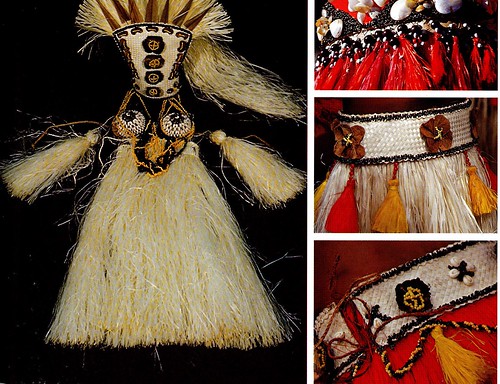
She talks about all the rules surrounding the annual Heiva I Tahiti competition. No man made materials allowed, dancers have to dance entering and exiting the stage, the size of the group and etc.
She does seem saddened by how the dance has changed a bit to accommodate hotel shows. But overall I think the book holds it own in 2017.
She even has diagrams of the movements for men and women.
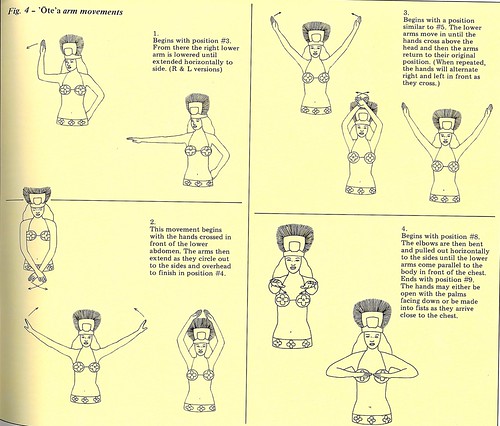
And it has a lot of nice group shots.
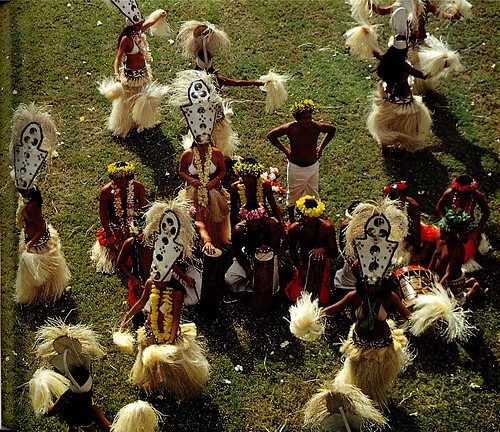
Sometimes these groups can have around 70 dancers and it is totally choreographed.
The book also helped me understand my South Pacific record collection (over on the Phonotiki) better. I also focus on music from Tahiti and now I realize I have many albums from many of the mover and shakers of the late 1960's-1970's who were keeping the dance alive (Coco!). I also learned a little more terminology of certain dance styles that are on the Lps.
Have a look at some videos here and Full Videos here.
And if you want to find out where you can see and learn Tahitian Dance click here.
Dr. Jane Freeman Moulin is a Professor of Music at the University of Hawaii at Manoa and is currently working on a book about Tahitian music.
Thursday, June 22, 2017
Savages by Shirley Conran
Savages by Shirley Conran. 1987
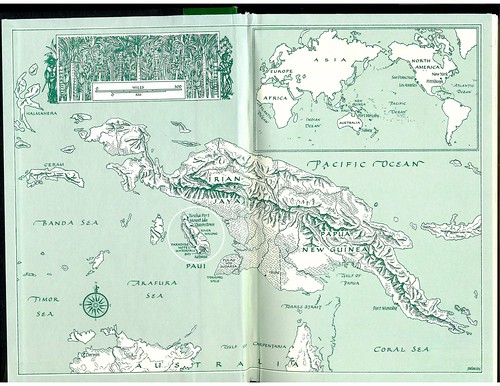
It was a good day at the thrift store up north. My husband and I went on a mini vacation and while on our way home went to a Goodwill. I had walked in and commented that I hope I find a tiki mug. In the next 30 seconds my husband plucks a vintage pineapple mug that still had the top attached off the shelf. Well that was easy. I look around and see some book called Savages. I always look at books that sounds jungle-like just in case the South Pacific is hiding inside. I open it up to a map of Papua New Guinea and think that I am on the right track.
I see on the cover it says it is by the author of Lace. I recall nothing about it except it is was a mini series with Phoebe Cates and was suppose to be a bit salacious. For $2.49 I figure I can gamble on it.
This book is about a group of women who have to go on a business trip with their husbands to Australia, PNG and the fictional island off of PNG called Paui. There is a lot of backstory on these women and their family life. I kept getting them confused and no one has much of a personality.
Eventually they make it to Paui and do to some shady business dealings most of the men are killed when the women are off on a 3 hour tour. The women return in time to see their husbands killed and a military coup in action. They leave with the captain of their ship and try to survive in Paui until they can figure out how to get back to civilation.
Lucky for them their captain is a great survivalist and teaches them many lessons before of course he dies.
As one would suspect, there is some light sexual action since this is the author of Lace. The ending is a bit grim and not really the direction I thought the book was going.
Overall it wasn't a bad read and you could tell it was well researched. I might of learned a survival skill or two. I think it was suppose to be a mini series as well but I can't find any evidence that they filmed it.
In case you were wondering where Paui is.

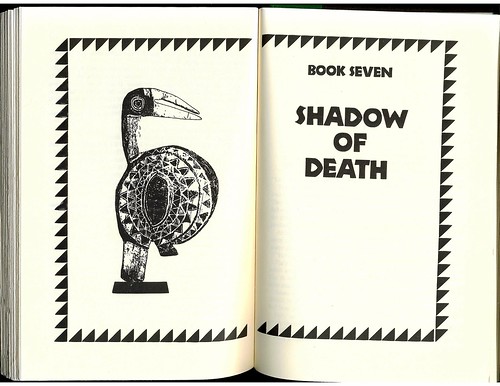
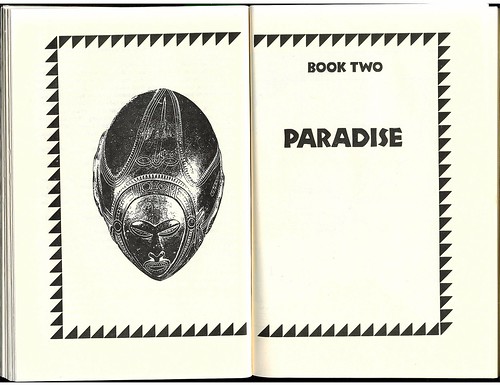
I liked the illustrations for each part of the book.


Lastly, here is a nice article about the author who they call Queen of the Bonkbuster.
It was a good day at the thrift store up north. My husband and I went on a mini vacation and while on our way home went to a Goodwill. I had walked in and commented that I hope I find a tiki mug. In the next 30 seconds my husband plucks a vintage pineapple mug that still had the top attached off the shelf. Well that was easy. I look around and see some book called Savages. I always look at books that sounds jungle-like just in case the South Pacific is hiding inside. I open it up to a map of Papua New Guinea and think that I am on the right track.
I see on the cover it says it is by the author of Lace. I recall nothing about it except it is was a mini series with Phoebe Cates and was suppose to be a bit salacious. For $2.49 I figure I can gamble on it.
This book is about a group of women who have to go on a business trip with their husbands to Australia, PNG and the fictional island off of PNG called Paui. There is a lot of backstory on these women and their family life. I kept getting them confused and no one has much of a personality.
Eventually they make it to Paui and do to some shady business dealings most of the men are killed when the women are off on a 3 hour tour. The women return in time to see their husbands killed and a military coup in action. They leave with the captain of their ship and try to survive in Paui until they can figure out how to get back to civilation.
Lucky for them their captain is a great survivalist and teaches them many lessons before of course he dies.
As one would suspect, there is some light sexual action since this is the author of Lace. The ending is a bit grim and not really the direction I thought the book was going.
Overall it wasn't a bad read and you could tell it was well researched. I might of learned a survival skill or two. I think it was suppose to be a mini series as well but I can't find any evidence that they filmed it.
In case you were wondering where Paui is.

I liked the illustrations for each part of the book.


Lastly, here is a nice article about the author who they call Queen of the Bonkbuster.
Sunday, August 28, 2016
Tahitian-English Dictionary
Tahitian- English / English-Tahitian Dictionary published by Leonard Clairmont.
I had been looking for an Tahitian Dictionary for a few years and this one just fell into my lap. A friend who I buy many of my Polynesian records from just gave it to me, but he was unaware of my quest for it.
This is a very slim volume and by no means comprehensive. I assume it was aimed at the tourist to Tahiti in the 1960's but probably not super useful.
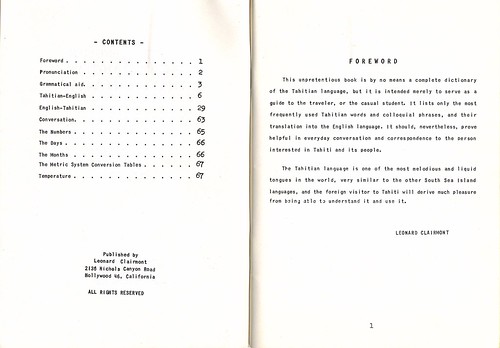
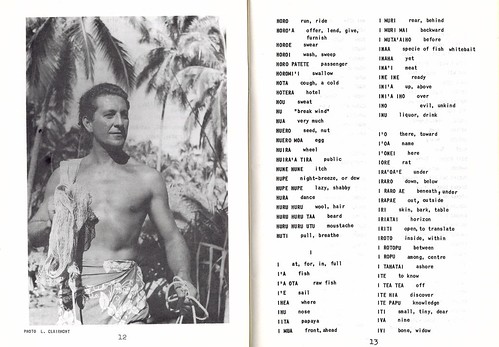
The table of contents covers the basics

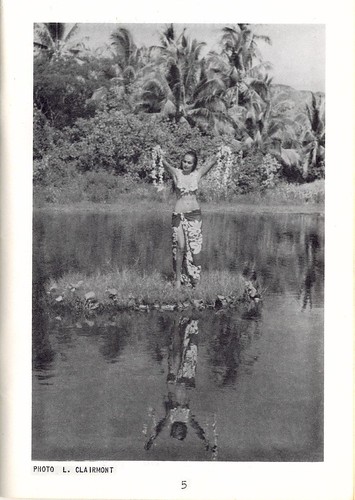
It does have some nice photos though


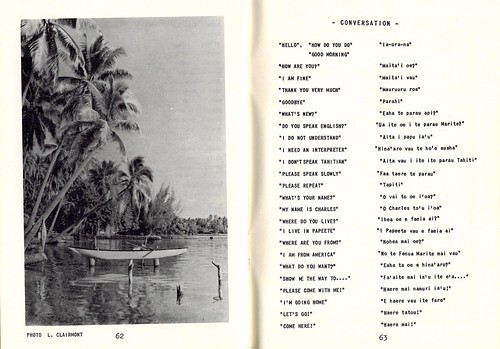
And does include some phrases you might need.

And now I can say toilet in Tahitian! Fare iti
I had been looking for an Tahitian Dictionary for a few years and this one just fell into my lap. A friend who I buy many of my Polynesian records from just gave it to me, but he was unaware of my quest for it.
This is a very slim volume and by no means comprehensive. I assume it was aimed at the tourist to Tahiti in the 1960's but probably not super useful.
The table of contents covers the basics

It does have some nice photos though


And does include some phrases you might need.

And now I can say toilet in Tahitian! Fare iti
Monday, July 4, 2016
Secrets of Diamond Head by Denby Fawcett
Secrets of Diamond Head by Denby Fawcett. 2015
Diamond Head, what could be a more iconic representation of Hawaii? If you go to Oahu you fly over it, you can see it from anywhere on Waikiki Beach and cheesy books have been written about it.
Though the Secrets of Diamond Head by no means is a cheesy book. It is actually pretty wonderful if you want to know the history and see some really great historical images of Diamond Head through advertising and photos.
In addition, it contains a trail guide that is annotated, how the crater was created and history of Hawaiian and the military presence on Diamond Head. The chapter I found most interesting was about saving Diamond Head. It is a miracle that there isn't a luxury hotel or a condo on the slopes of Diamond Head but that is due to the energy many have fought to make sure that doesn't happen.
If you have never hiked Diamond Head here are a few tips:
You can pick up this book thru the University Of Hawaii Press site.
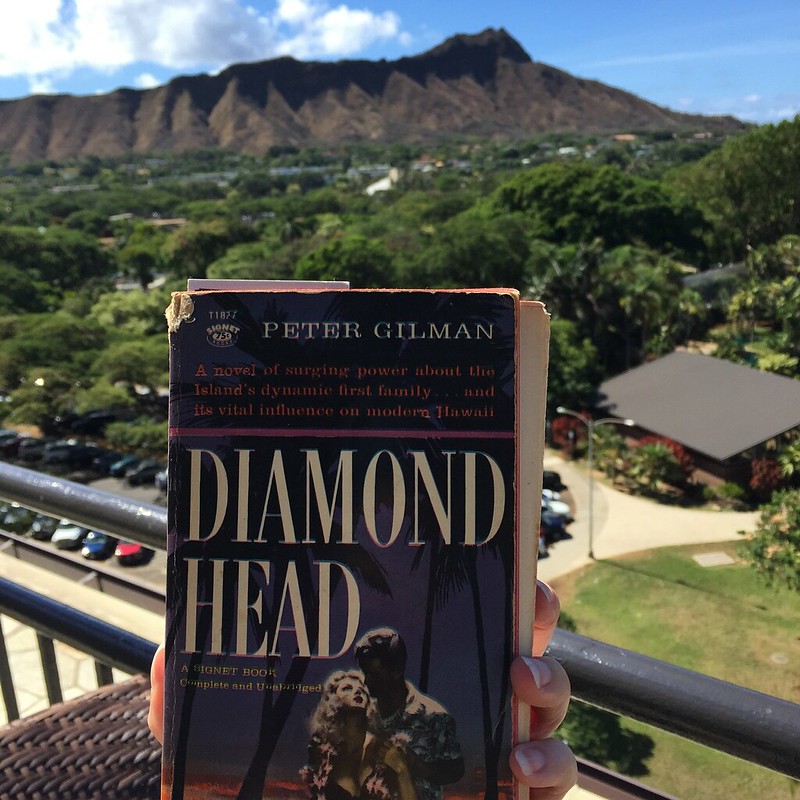
July 2015, sitting on the balcony of my hotel, getting ready to read this classic.

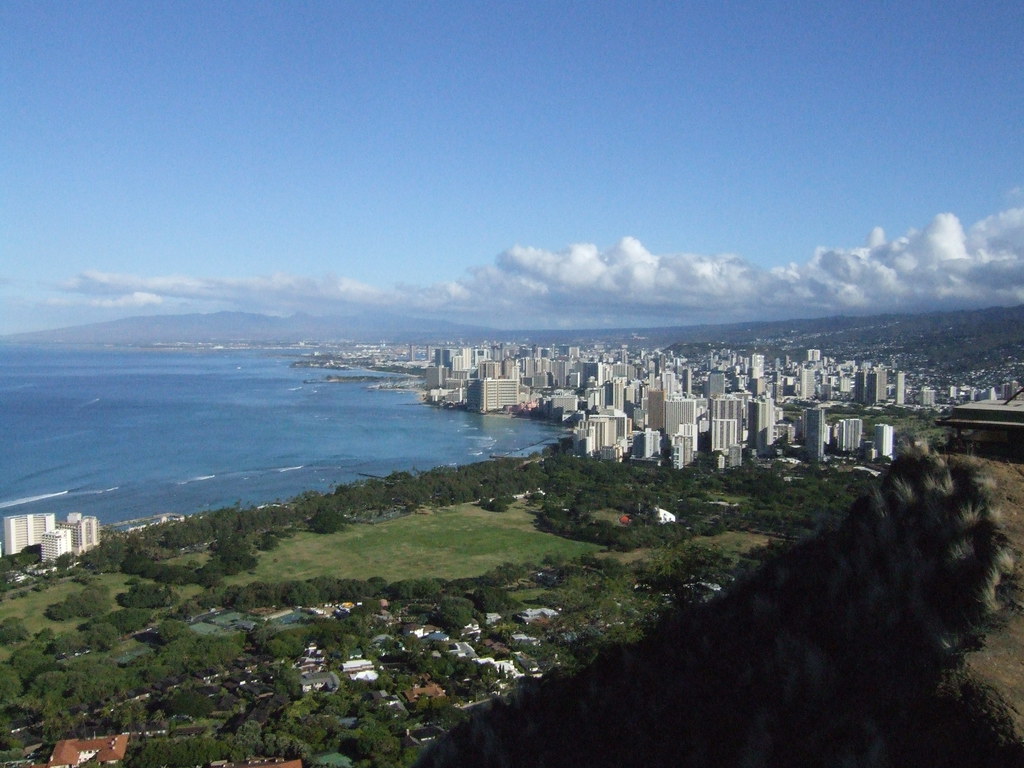
View from Diamond Head
Diamond Head, what could be a more iconic representation of Hawaii? If you go to Oahu you fly over it, you can see it from anywhere on Waikiki Beach and cheesy books have been written about it.
Though the Secrets of Diamond Head by no means is a cheesy book. It is actually pretty wonderful if you want to know the history and see some really great historical images of Diamond Head through advertising and photos.
In addition, it contains a trail guide that is annotated, how the crater was created and history of Hawaiian and the military presence on Diamond Head. The chapter I found most interesting was about saving Diamond Head. It is a miracle that there isn't a luxury hotel or a condo on the slopes of Diamond Head but that is due to the energy many have fought to make sure that doesn't happen.
If you have never hiked Diamond Head here are a few tips:
- Get there early! Like 7am early or else it is too crowded and too hot
- Bring water
- Wear comfy shoes and clothes
- If you go on a Saturday, visit the nearby KCC farmers market. So much good food and drink there.
You can pick up this book thru the University Of Hawaii Press site.
July 2015, sitting on the balcony of my hotel, getting ready to read this classic.

View from Diamond Head
Friday, August 21, 2015
White Savages in the South Seas by Mel Kernahan
In my readings over the last few years about the South Pacific, I kept seeing references to this book. Some were dismissive of it and after reading it I can only surmise they don't like their idyllic view of islanders busted.
I greatly enjoyed this book. And since I like to focus on woman writes of South Pacific literature I found Mel to be quite the character. The first paragraph on the back of this book pretty much sums it up:
White Savages in the South Seas is a book about Polynesia after the cruise ship has sailed, the jet has flown off into the sunset and the maitai curtain has dropped on a dream that was more performance than reality.She has been visiting Polynesia since her first trip in 1959 and the book covers to 1992, which is a pivotal time period of change in that region due to the impact from the west. Before you had easier air travel, the amount of visitors wasn't so great. But then it all changed...
She starts off in Tahiti, going to the very first strip show in 1966. Apparently it was not a success. You might think the book will just be a laugh but she quickly moves on to politics and nuclear testing that the French did in the islands. She does then lighten it up a bit with a story about Susy No Pants and dancing at the infamous Quinn's bar in Tahiti. I am always curious to hear about Quinn's since it is mentioned in many books and I have some LP's that were recorded there. It sounds like a total dive and kinda wonderful.
The middle of the book contains a depressing story of when Mel is back in California and stumbles upon a local spot visited by Tahitians who have moved here. Including one young girl whose island was pretty much destroyed by the nuclear testing by the French and her misery of having no home.
I was enjoying the book and then it really gripped me once she got the Cook Islands. I went to the Cook Islands on my honeymoon many years ago and always have an interested in them. Even though she was writing about the Cooks about 10 years before I went there, it brought back a lot of memories of what the islands were like especially with her part about staying on Aitutaki.
She has a chapter where she takes her dream boat ride on a cargo ship to another island. And then is sick as a dog due to a massive storm and seasickness. It is called "Damn you Robert Dean Frisbie". RDF is a legend in Polynesian literature which includes the infamous story of him tying his children to a coconut tree in a hurricane on an island in the Cooks. I too have a dream of taking a cargo ship to around to the island but now realize I would probably wind up like her, heaving over the side of the boat.
I will leave you with a quote from the book that really rang true for me and also would for those who love the "paradise" version of the South Pacific but know it isn't real.
'Damn you, Robert Dean Frisbie', I say aloud, ' and all the rest of your motley crew of misfit dream spinners, including you, James Norman Hall and Charles Nordhoff; Beatrice Grimshaw and Frederick O'Brien; damn you Robert Louis Stevenson and W. Somerset Maugham - I wish I loved you less'...
'Damn you for making such a glory out of unrequited love. Damn your loneliness, damn your pain. Damn your longing, damn your books, your words, your sirens' words - which can be the only mates of people like us who yearn to belong to an image of the South Seas...'
Friday, January 9, 2015
In the Heart of the Sea: The Tragedy of the Whaleship Essex by Nathaniel Philbrick
In the Heart of the Sea: The Tragedy of the Whaleship Essex by Nathaniel Philbrick. 2000
On Christmas Eve, we were out seeing a movie (Big Eyes) and I noticed a movie poster for In the Heart of the Sea. I thought, "hey, I have that book in the Bibliotiki, maybe now is a good time to read it." I had bought this book years ago because I had read it was a true story that Melville based Moby Dick on. I do love non-fiction books based on adventure so this seemed right up my alley.
I should say my 2 top true adventure books are the Kon Tiki by Thor Heyerdahl and Men Against the Sea by Nordoff and Hall. Men Against the Sea is a gripping story about how Captain Bligh got forced off his ship and into a boat with others left to die. They didn't die and their tale of navigation and survival is a page turner. So I did have high expectations for In the Heart of the Sea going into it.
Philbrick did a great job with the research of this book. 40 pages of this book are notes and bibliography. It mainly weaves the two books that survivors wrote as the narrative, which I will be interested to see how the movie handles that.
It starts off with a pretty amazing opening chapter, survivors of the Essex are found by another ship and this is what they saw:
Let me say, if the movie doesn't open with that scene, it is a missed opportunity.
With that as the preface, you pretty much know what your in for. But it isn't all horror and gore, you get a lot of information about Nantucket and the whaling industry. It was just such a different time then our own.
The story in a nutshell is an inexperienced crew leave Nantucket to catch some whales, a whale then attacks their ship. The crew then escapes into 3 smaller whaleboats that are in various state of disrepair. They should head for Tahiti which is not that far but are afraid of cannibals (cue the foreshadowing) and decide to take the longest, most desolate route possible to South America.
Overall, it is a pretty amazing story.
Here is a link to the Nantucket Whaling Museum which has some artifacts from the crew on display. Including a skeleton of a 46 foot sperm whale. I have never been to Nantucket but now I kinda want to go.
And of course a link to the trailer for the new movie. Hopefully I won't sit thru it and go "it didn't happen like that in the book!" to my husband 400 times.
*Update, I watched the movie in June 2016. it is kinda of stinker. Looks nice but just read the book, it is 1000xs better.
On Christmas Eve, we were out seeing a movie (Big Eyes) and I noticed a movie poster for In the Heart of the Sea. I thought, "hey, I have that book in the Bibliotiki, maybe now is a good time to read it." I had bought this book years ago because I had read it was a true story that Melville based Moby Dick on. I do love non-fiction books based on adventure so this seemed right up my alley.
I should say my 2 top true adventure books are the Kon Tiki by Thor Heyerdahl and Men Against the Sea by Nordoff and Hall. Men Against the Sea is a gripping story about how Captain Bligh got forced off his ship and into a boat with others left to die. They didn't die and their tale of navigation and survival is a page turner. So I did have high expectations for In the Heart of the Sea going into it.
Philbrick did a great job with the research of this book. 40 pages of this book are notes and bibliography. It mainly weaves the two books that survivors wrote as the narrative, which I will be interested to see how the movie handles that.
It starts off with a pretty amazing opening chapter, survivors of the Essex are found by another ship and this is what they saw:
First they saw bones-human bones-littering the thwarts and floorboards, as if the whaleboat where the seagoing lair of a ferocious man-eating beast. Then they saw the two men. They were curled up in opposite ends of the boat, their skin covered with sores, their eyes bulging from the hollows of their skulls, their beards caked with salt and blood. They were sucking the marrow from the bones of their dead shipmates.
Let me say, if the movie doesn't open with that scene, it is a missed opportunity.
With that as the preface, you pretty much know what your in for. But it isn't all horror and gore, you get a lot of information about Nantucket and the whaling industry. It was just such a different time then our own.
The story in a nutshell is an inexperienced crew leave Nantucket to catch some whales, a whale then attacks their ship. The crew then escapes into 3 smaller whaleboats that are in various state of disrepair. They should head for Tahiti which is not that far but are afraid of cannibals (cue the foreshadowing) and decide to take the longest, most desolate route possible to South America.
Overall, it is a pretty amazing story.
Here is a link to the Nantucket Whaling Museum which has some artifacts from the crew on display. Including a skeleton of a 46 foot sperm whale. I have never been to Nantucket but now I kinda want to go.
And of course a link to the trailer for the new movie. Hopefully I won't sit thru it and go "it didn't happen like that in the book!" to my husband 400 times.
*Update, I watched the movie in June 2016. it is kinda of stinker. Looks nice but just read the book, it is 1000xs better.
Friday, December 26, 2014
Tahiti Holiday by Sydney Gorham Babson
Tahiti Holiday by Sydney Gorham Babson. 1943I picked this up at the wonderful Powell's City of Books in Portland a few years ago on my first trip to Portland. I recall being overwhelmed by the breathe of titles they had in the Polynesian literature section. I guess my judgement must of been clouded that I choose this book. I know I also bought a book about headhunting as well, hopefully that title will prove a little more interesting.
My main problem with this book is, only about 1/3rd of it is about Tahiti. The rest of the book is about Bali and then a random collection of the author poems.
Poems.
Poems, despite having a best friend who is a poetess I have never been very keen on poetry. I blame too many Voodoo donuts on this choice.
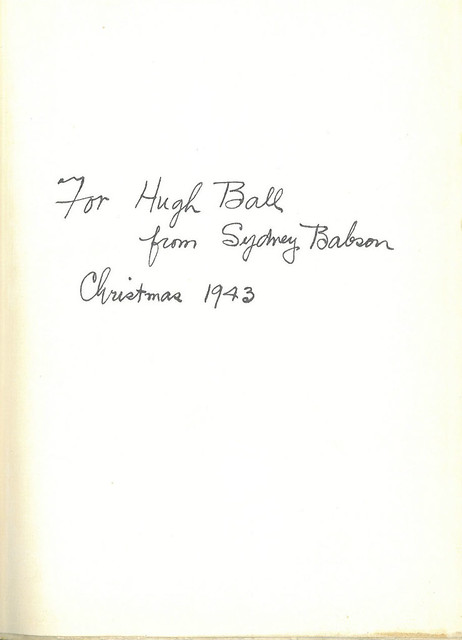
It was signed so maybe that swayed my purchasing decision as well.

The part of the book that does deal with Tahiti was fine, if I bit emotionless. The author went to Tahiti in 1938, the first part is written a diary style format so we get a day by day account. He leaves from Pago Pago then to Fiji. Gets stuck in Fiji for awhile waiting for his next boat. Then goes to Tonga which he enjoyed more then Fiji. Next up is Samoa and then he finally makes it to Tahiti.
Now the book goes from diary format to just travelogue. He seems to have your usual visit to Tahiti in the 1930's, goes to Quinns, gets the hots for a local girl, swims in Loti's pool, briefly meets Zane Grey but misses meeting James Norman Hall.
He does make it to Moorea but the excitement of Papeete calls him back to Tahiti. He did get to meeting Charles Nordhoff but had nothing to say about it except they shared a lemonade.
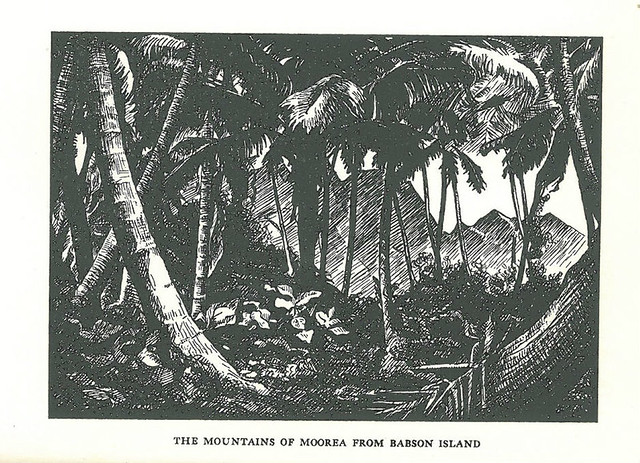
The few decorations by Dorothy Goodwin Blodgett are nice.

Then it goes into his poetry inspired by his trip. He has a little more emotion over the local lady he had the hots for but that was about it.
Then the book goes into Bali and Java where there is much written about topless ladies. I did enjoy the illustration of the man with a huge leaf on his back as a rain coat.

And then we get about 50 pages of poetry that has nothing to do with Polynesia, Bali or Java.
Can't say this is my favorite idem in the Bibliotiki. Since space is getting tight, it might be going away.
I did look up the author and did find some interesting tidbits. Copied from this site.
Sydney Gorham Babson born 1882 at Brooklyn, NY; died 11 Jan 1975 at Hood River, OR at age 92.
He was graduated After graduating from Princeton in 1902 he worked for a time in New York City with Sinclair & Babson, wholesalers of Portland Cement, and then with the Vulcanite Portland Cement Company. Sydney and his brother Rea then moved to Oregon where they cleared the forest in the newly-settled Upper Hood River Valley. They planted one of the first commercial apple and pear orchards in the area. Sydney devoted his life with single-minded purpose to these orchards for over 60 years. In 1960 he was named "Orchardist of the Year."
Sydney was also a writer. Among the books he authored were Tahiti Holiday, Green Wave of Mexico, and Complete Poems. His poem Verdun was published in the New York Times of 29 March 1917.
Well, next time I have an apple in Portland I will think of him.
Wednesday, April 30, 2014
Savage Harvest by Carl Hoffman
Savage Harvest by Carl Hoffman. 2014
It pretty much starts off with a graphic description of what would of happened if he indeed was killed and ate by the Asmat people. Let me say that again, a VERY graphic description. I wasn't quite prepared for that. But I pressed on and ripped thru this book pretty fast. I am a sucker for a true history mystery.
I did enjoy this book on many levels. I liked hearing about the research the author did on Michael and the time period. I think he did a good job setting the stage for the extenuating circumstances that were going on. I liked reading about the author and his interest in extreme cultures and how he actually immersed himself by learning the language and living with an Asmat family.
Here is a 3 minute video of an interview with the author and on location footage.
I would of liked to of gotten more of a sense of who Michael was as person. We knew he had graduated college recently and had two trips to the region to collect art for his father's new Primitive Art Museum. One problem is, this was 53 years ago and any remaining family or friends of Michael are not going to want to talk to an author who is once again digging up the headhunting story. It seems that the family believes the official story that he drowned. Do they really need to believe the possible truth that some primitive men ate him? How horrible to think that happened to a loved one? Overall, a worthy read. Just a bizarre mixture of culture clashing, politics, art and lies.
To try get a little more of Michael as a person, I interlibrary loaned: Asmat by Michael C Rockefeller.
I also interlibrary loaned Michael Rockefeller: New Guina Photographs, 1961 by Kevin Bubriski. These photos are from his first trip where he photographed the Dani tribe.
If you are in New York, you can visit the Michael C. Rockefeller wing at the Metropolitan Museum of Art.
Friday, April 4, 2014
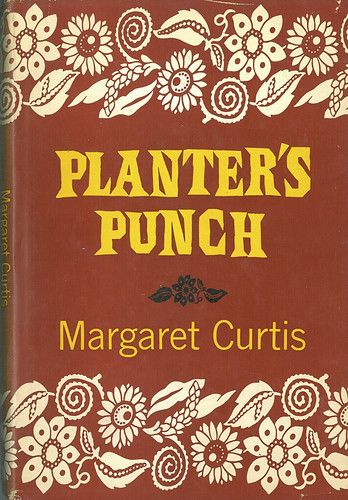
Planter's Punch by Margaret Curtis
Planter's Punch by Margaret Curtis. 1962

I fear I will not be able to do justice to this fascinating woman's biography. I had never heard of Margaret Curtis, but I was at the Friend's of The Library Book Sale last year and the flowers on the spine of this book caught my eye. I had hoped the title was a reference to the tiki drink that is one of my favorites. When I read the flyleaf and it mentioned "Tahiti" and "Nordhoff and Hall" I knew I was in.
I fear I might overuse the phrase "truth is stranger then fiction" on the Bibliotiki but gosh darn it, it IS! Pretty much the entire time of reading the account of this womans' life I was bowled over from how interesting and varied it was.
Any short period of her life would be a lifetime for others: "World famous opera singer." "Lived and ran a coconut plantation on Tahiti." "Spent time in an Italian jail" "Had a harrowing escape from Europe during WWII."
I mean COME ON!?!?! Where people just more interesting in the old days?

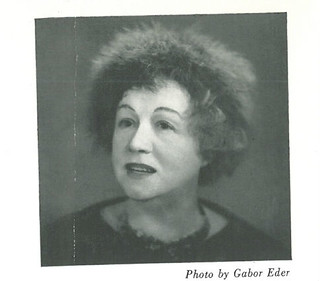
Plus look at her! Is that the face of someone who stole her husband away from the best Tahitian dancer on the island named Tetua. Apparently it is.
I finished this book about 2 months ago and have been trying to do some research on Margaret to add to my review and have just been coming up short. I did find a clipping from December 28, 1913 New York Time's that mentioned she sang. Her stage name was Marguerite Valdi.
Sadly, since I waited so long to write this up I realized I have forgotten many wonderful things that happened in this book. As I flip thru it now, it takes me back to when I was reading it and how unbelievable I thought it was.
Here is just a brief outline of her life: She was born in Birmingham, England. Her father was a newspaper writer but due to his poor health they had to move to Australia. There it was discovered she could sing and studied with Nellie Melba, a famous Australian Soprano. Thru the magic of Google, I found out that Nellie is a character on Downton Abbey so there is a tidbit for you fans. Ok back to Margaret. She then went to study music in Paris, got famous, traveled the world, married a rich older man, got tossed in an Italian jail, husband then died, bought a ticket to a ship traveling overseas, met and married husband #2 who owned a plantation on Tahiti, volunteered to help during WWII, had to quickly escape Europe, husband #2 accidentally dies, moves to San Francisco where she threw elaborate Tahitian themed parties. Phew. That is just the barest of outlines. You need to read the book if you want to fill in the details.
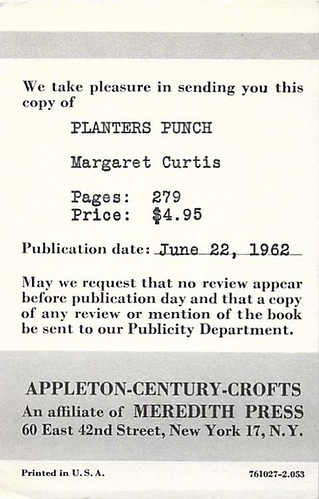
There are many copies of the book available online and many of them signed. My copy came with this card from the publisher so I am assuming mine was a review copy. Sadly, I can't even find Margaret's birth or death date. If anyone has any info about Margaret, please email me. I am going to keep looking.
In closing, you can buy this book online for around $13 and I guarantee it will be a exciting, fun read. Or maybe you will luck out and find it at your library book sale.

I fear I will not be able to do justice to this fascinating woman's biography. I had never heard of Margaret Curtis, but I was at the Friend's of The Library Book Sale last year and the flowers on the spine of this book caught my eye. I had hoped the title was a reference to the tiki drink that is one of my favorites. When I read the flyleaf and it mentioned "Tahiti" and "Nordhoff and Hall" I knew I was in.
I fear I might overuse the phrase "truth is stranger then fiction" on the Bibliotiki but gosh darn it, it IS! Pretty much the entire time of reading the account of this womans' life I was bowled over from how interesting and varied it was.
Any short period of her life would be a lifetime for others: "World famous opera singer." "Lived and ran a coconut plantation on Tahiti." "Spent time in an Italian jail" "Had a harrowing escape from Europe during WWII."
I mean COME ON!?!?! Where people just more interesting in the old days?

Plus look at her! Is that the face of someone who stole her husband away from the best Tahitian dancer on the island named Tetua. Apparently it is.
I finished this book about 2 months ago and have been trying to do some research on Margaret to add to my review and have just been coming up short. I did find a clipping from December 28, 1913 New York Time's that mentioned she sang. Her stage name was Marguerite Valdi.
Sadly, since I waited so long to write this up I realized I have forgotten many wonderful things that happened in this book. As I flip thru it now, it takes me back to when I was reading it and how unbelievable I thought it was.
Here is just a brief outline of her life: She was born in Birmingham, England. Her father was a newspaper writer but due to his poor health they had to move to Australia. There it was discovered she could sing and studied with Nellie Melba, a famous Australian Soprano. Thru the magic of Google, I found out that Nellie is a character on Downton Abbey so there is a tidbit for you fans. Ok back to Margaret. She then went to study music in Paris, got famous, traveled the world, married a rich older man, got tossed in an Italian jail, husband then died, bought a ticket to a ship traveling overseas, met and married husband #2 who owned a plantation on Tahiti, volunteered to help during WWII, had to quickly escape Europe, husband #2 accidentally dies, moves to San Francisco where she threw elaborate Tahitian themed parties. Phew. That is just the barest of outlines. You need to read the book if you want to fill in the details.
There are many copies of the book available online and many of them signed. My copy came with this card from the publisher so I am assuming mine was a review copy. Sadly, I can't even find Margaret's birth or death date. If anyone has any info about Margaret, please email me. I am going to keep looking.
In closing, you can buy this book online for around $13 and I guarantee it will be a exciting, fun read. Or maybe you will luck out and find it at your library book sale.
Sunday, January 26, 2014
This is Paradise by Kristiana Kahakauwila
This is Paradise by Kristiana Kahakauwila 2013.
I came across this book at work (public library) the other week. Of course I stopped when I saw the hula girl on the cover but then I knew I wanted to read it when I saw the author's last name was Hawaiian. While I love my books on the historical take of the South Pacific, I do want learn about how things really are today. Also, I like the Bibliotiki to have a focus on women writer's so this seemed perfect.
It is a collection of short stories that all take places on various islands in Hawaii. If you were looking for heart warming travel stories about an idyllic place, just stop right there and back away from this book. Also, if you aren't good with understanding pidgin this might make it a difficult book at times.
These are fictional stories about contemporary, current Hawaii. It is not all sensational Dog the Bounty Hunter type characters or drama but it can be pretty heavy, kinda of like how Hawaii actually is if you scratch the surface.
I imagine that many of these very vivid characters come from actual people in the author's life. There were only a few stories that I didn't like the characters or the story much. One being Road to Hana, where a Hawaiian native has move back home and is with her Haole boyfriend. The story had promise but then just kinda of ended.
One of the best stories I thought was Thirty-Nine Rules for Making a Hawaiian Funeral into a Drinking Game. Very dark humor in it and a great portrayal of an extended family. The first story in the collection, This is Paradise, really sets the tone for the book. A story of a young tourist coming to Hawaii for vacation and her interaction with the locals.
While the book is based in Hawaii, it is really about those universal themes of love, death and family.
It isn't very long, 238 pages. None of the stories are connected so it's great if you just want to pick up and read one story at a time. I believe this is her first book/collection, I really hope she will have more coming out in the near future.
I came across this book at work (public library) the other week. Of course I stopped when I saw the hula girl on the cover but then I knew I wanted to read it when I saw the author's last name was Hawaiian. While I love my books on the historical take of the South Pacific, I do want learn about how things really are today. Also, I like the Bibliotiki to have a focus on women writer's so this seemed perfect.
It is a collection of short stories that all take places on various islands in Hawaii. If you were looking for heart warming travel stories about an idyllic place, just stop right there and back away from this book. Also, if you aren't good with understanding pidgin this might make it a difficult book at times.
These are fictional stories about contemporary, current Hawaii. It is not all sensational Dog the Bounty Hunter type characters or drama but it can be pretty heavy, kinda of like how Hawaii actually is if you scratch the surface.
I imagine that many of these very vivid characters come from actual people in the author's life. There were only a few stories that I didn't like the characters or the story much. One being Road to Hana, where a Hawaiian native has move back home and is with her Haole boyfriend. The story had promise but then just kinda of ended.
One of the best stories I thought was Thirty-Nine Rules for Making a Hawaiian Funeral into a Drinking Game. Very dark humor in it and a great portrayal of an extended family. The first story in the collection, This is Paradise, really sets the tone for the book. A story of a young tourist coming to Hawaii for vacation and her interaction with the locals.
While the book is based in Hawaii, it is really about those universal themes of love, death and family.
It isn't very long, 238 pages. None of the stories are connected so it's great if you just want to pick up and read one story at a time. I believe this is her first book/collection, I really hope she will have more coming out in the near future.
Tuesday, April 30, 2013
Revolt of Mamie Stover and Hotel Mamie Stover by William Bradford Huie
Revolt of Mamie Stover by William Bradford Huie 1951
Hotel Mamie Stover by William Bradford Huie 1963

My husband came home from a yard sale one day with a bunch of old paperbacks for me which included the Revolt of Mamie Stover. At first glance I just thought it was some pulpy novel since by looking at the cover nothing would suggest that this is set in Hawaii. The cover just had some busty blond looking really pissed off, I assumed since she had to "service" 51,840 soldiers.
The fictional author, Madison, meets Mamie on board a freight to Honolulu. He finds out she is from a small southern town and went to be an actress in Hollywood but that didn't go so well for her. She got in trouble with a gangster who roughed her up and sent her packing to a whorehouse in Hawaii. Madison is sympathetic and tries to give her money to start a different kind of life but she is determined to be the best damn whore in the south pacific. It is nice to have a goal.
Madison is successful writer who lives in an exclusive part of Oahu and seems intrigued and disgusted by the whole prospect.
They keep in touch and she uses him to help squirrel her money away since she isn't allowed to open a bank account.
Once World War II hits she can really make her mark. She breaks all the 13 rules that the Hawaii whores are suppose to abide by. She also builds a "bullring."This is some multi-roomed structure where she can service as any men as she can. She makes her millions, invests in property, takes over the whore house and retires from the business. A true American success story.
Despite the book being about a whore, there is hardly any sex in it and nothing remotely graphic. I would think folks in 1951 might of been bummed by it. Here they think they are getting a raunchy sex book but instead get a meditation on the class system. It is a strange book that is actually more a commentary about social status in America and the minorities rising in the ranks. When I finished the booked I googled the author to try and get some insight and found out he was from the south and was very involved in the civil right movement in the south. Then the book made a little more sense.
Thanks to the magic of YouTube you can now watch the 1956 movie version with Jane Russell here. Though as you can imagine it is a bit cleaned up and there is no bullpen. It does appear to be filmed in Hawaii so worth watching for that alone.
The end of the book left me hanging and with a little googling I saw there is a sequel from 1963 called Hotel Mamie Stover, I ordered a used one off of Amazon and with promises of "A veritable Sexual Disneyland" pull quote from the San Francisco Chronicle on the cover I thought surely this has to be saucier.
What I received instead was kinda of a slog to get thru. And it hardly had any Mamie in it. It picked up a

few years after the first book. Mamie and 2 business partners are now running a sex resort on Maui. First you go to a Luau that Mamie puts on in Waikiki then you submit your application to the resort. They do no advertising, just word of mouth. But OH NO, James Madison is back and is suppose to write a story about the luau and resort for a Hawaii vacation magazine that will blow the lid right off!! Sound exciting? It's not. Really.
The story then turns to be centered around a late 20's virgin from the midwest who wants to loose her virginity at the resort. The other stories are about couples who go to the resort. And like in the last book there is no sex, nothing erotic just lots of talk about "like sex." Which is what you have when you are not in love.
I feel bad for the readers in the early 50's and 60's who picked up these books thinking they where going to get a titillating beach read. They must of wanted their 60 cents back.
I can lukewarmly recommend the Revolt of Mamie Stover, it was interesting in a historical way and Mamie was a spitfire of a character. I can't recommend Hotel Mamie Stover unless you have insomnia and need some help in that department.


Hotel Mamie Stover by William Bradford Huie 1963
My husband came home from a yard sale one day with a bunch of old paperbacks for me which included the Revolt of Mamie Stover. At first glance I just thought it was some pulpy novel since by looking at the cover nothing would suggest that this is set in Hawaii. The cover just had some busty blond looking really pissed off, I assumed since she had to "service" 51,840 soldiers.
The fictional author, Madison, meets Mamie on board a freight to Honolulu. He finds out she is from a small southern town and went to be an actress in Hollywood but that didn't go so well for her. She got in trouble with a gangster who roughed her up and sent her packing to a whorehouse in Hawaii. Madison is sympathetic and tries to give her money to start a different kind of life but she is determined to be the best damn whore in the south pacific. It is nice to have a goal.
Madison is successful writer who lives in an exclusive part of Oahu and seems intrigued and disgusted by the whole prospect.
They keep in touch and she uses him to help squirrel her money away since she isn't allowed to open a bank account.
Once World War II hits she can really make her mark. She breaks all the 13 rules that the Hawaii whores are suppose to abide by. She also builds a "bullring."This is some multi-roomed structure where she can service as any men as she can. She makes her millions, invests in property, takes over the whore house and retires from the business. A true American success story.
Despite the book being about a whore, there is hardly any sex in it and nothing remotely graphic. I would think folks in 1951 might of been bummed by it. Here they think they are getting a raunchy sex book but instead get a meditation on the class system. It is a strange book that is actually more a commentary about social status in America and the minorities rising in the ranks. When I finished the booked I googled the author to try and get some insight and found out he was from the south and was very involved in the civil right movement in the south. Then the book made a little more sense.
Thanks to the magic of YouTube you can now watch the 1956 movie version with Jane Russell here. Though as you can imagine it is a bit cleaned up and there is no bullpen. It does appear to be filmed in Hawaii so worth watching for that alone.
The end of the book left me hanging and with a little googling I saw there is a sequel from 1963 called Hotel Mamie Stover, I ordered a used one off of Amazon and with promises of "A veritable Sexual Disneyland" pull quote from the San Francisco Chronicle on the cover I thought surely this has to be saucier.
What I received instead was kinda of a slog to get thru. And it hardly had any Mamie in it. It picked up a
few years after the first book. Mamie and 2 business partners are now running a sex resort on Maui. First you go to a Luau that Mamie puts on in Waikiki then you submit your application to the resort. They do no advertising, just word of mouth. But OH NO, James Madison is back and is suppose to write a story about the luau and resort for a Hawaii vacation magazine that will blow the lid right off!! Sound exciting? It's not. Really.
The story then turns to be centered around a late 20's virgin from the midwest who wants to loose her virginity at the resort. The other stories are about couples who go to the resort. And like in the last book there is no sex, nothing erotic just lots of talk about "like sex." Which is what you have when you are not in love.
I feel bad for the readers in the early 50's and 60's who picked up these books thinking they where going to get a titillating beach read. They must of wanted their 60 cents back.
I can lukewarmly recommend the Revolt of Mamie Stover, it was interesting in a historical way and Mamie was a spitfire of a character. I can't recommend Hotel Mamie Stover unless you have insomnia and need some help in that department.
Sunday, January 6, 2013
Island of Shattered Dreams by Chantal T. Spitz
Island of Shattered Dreams by Chantal T. Spitz, 2007.
I came across this title in a University of Hawai'i Press catalog and was interested since it is a contemporary novel by an Tahitian author. I had read the Breadfruit trilogy years ago which is also by female Tahitian author but these books couldn't be more different.
Island is a doomed loved story that is highly critical of the French government and their nuclear testing. If you are looking for an armchair travel book about French Polynesia with their happy, nice locals and fun adventures, this is not for you.
In the Bibliotiki I don't just want to read 1930's travel journals by white men who go to Tahiti and fall in love with the beautiful local ladies. I want the full picture and sometimes that means the cold, hard reality of modern Polynesia and the history that got them there.
The book is translated from Tahitian and written in a more lyrical style that seems true to the Tahitian way of storytelling. It covers a few generations of a family and their frustrations, some from certain family members being of Tahitian-European decent and how that affects their lives. The book contains a story about a Tahitian-European man falling in love with a French woman on his island, who is there working for the government to build the first nuclear facility in French Polynesian. Talk about doomed love.
The book is translated by Jean Anderson and I think is the the only translated work by this author. From what I can gather from google translated websites from French, she seems to be a very passionate person about her culture in the modern world. I think this novel has many biographical elements to it, which makes it even more interesting.
I highly recommend this novel for those wanting a different view of the magic of Polynesia. If anyone has any suggestions of other contemporary others to check out, please feel free to leave a comment.
I came across this title in a University of Hawai'i Press catalog and was interested since it is a contemporary novel by an Tahitian author. I had read the Breadfruit trilogy years ago which is also by female Tahitian author but these books couldn't be more different.
Island is a doomed loved story that is highly critical of the French government and their nuclear testing. If you are looking for an armchair travel book about French Polynesia with their happy, nice locals and fun adventures, this is not for you.
In the Bibliotiki I don't just want to read 1930's travel journals by white men who go to Tahiti and fall in love with the beautiful local ladies. I want the full picture and sometimes that means the cold, hard reality of modern Polynesia and the history that got them there.
The book is translated from Tahitian and written in a more lyrical style that seems true to the Tahitian way of storytelling. It covers a few generations of a family and their frustrations, some from certain family members being of Tahitian-European decent and how that affects their lives. The book contains a story about a Tahitian-European man falling in love with a French woman on his island, who is there working for the government to build the first nuclear facility in French Polynesian. Talk about doomed love.
The book is translated by Jean Anderson and I think is the the only translated work by this author. From what I can gather from google translated websites from French, she seems to be a very passionate person about her culture in the modern world. I think this novel has many biographical elements to it, which makes it even more interesting.
I highly recommend this novel for those wanting a different view of the magic of Polynesia. If anyone has any suggestions of other contemporary others to check out, please feel free to leave a comment.
Wednesday, November 14, 2012
My Samoan Chief by Fay G. Calkins
My Samoan Chief by Fay G. Calkins, 1962.

Chapter one begins:
It is driving me nuts that I can't recall what bookstore I bought this in but I had it for a few months waiting for the right time to read it. I knew it would be good. Finally it went on vacation with me to Las Vegas and Florida and was a great travel book.
Here at the Bibliotiki, we do have a focus on South Pacific Literature written by women, well because I am a woman. As I look at my bookshelves I have 1 cube that has books by women and 7 that are by men. So I am always on the hunt for something good by the ladies and this did not disappoint.
The book starts off with Fay working on her doctoral dissertation in the Library of Congress where she is assigned a student desk. She has mysterious neighbors who leave things like chicken bones in the wastebasket and ukuleles on the desk. She finally met her neighbor, who was Vaiao John Ala'ilima from the island of Samoa.
The book continues with tales of them dating. In 1952, they married and then they move to Samoa so Vai, who was one of the first graduates from Samoa, could help his country out.
I hate to use the word charming but boy this book is. Stories about her adjusting to the Samoa way, trying to build a home and raise children, were just charming but not in an annoying way.
The book also includes some pen and ink illustrations by Vasiliu but no mention of who that is.
I wish the book had more personal anecdotes but I do come from a different time (ruined by reality tv) were back then that wasn't as common.
After reading the book, I googled Fay and found a sweet website set up in her memory. It has more about her biography, which is pretty amazing. It also includes some family history ( 7 kids!). And mentions her other works, I did not know she wrote a biography about Aggie Grey (who is mentioned in this book) which I will have to locate.
I recommend this book to all who are interested in the South Pacific, it made me want to read more about Samoa (R.L. Stevenson, I'm looking at you). Absolutely charming, damn I said it again!
Chapter one begins:
"I squinted through my glasses, clutched my zipper notebook, and hoped I would pass as an egghead. The dome of the Library of Congress looked very awesome from underneath as I tiptoed around the great circular call desk and back through the card catalogues..."Wait a minute, a book about the South Pacific that starts off in a library? I don't even need to think twice, here is my $3 and I will be on my way, thank you very much.
It is driving me nuts that I can't recall what bookstore I bought this in but I had it for a few months waiting for the right time to read it. I knew it would be good. Finally it went on vacation with me to Las Vegas and Florida and was a great travel book.
Here at the Bibliotiki, we do have a focus on South Pacific Literature written by women, well because I am a woman. As I look at my bookshelves I have 1 cube that has books by women and 7 that are by men. So I am always on the hunt for something good by the ladies and this did not disappoint.
The book starts off with Fay working on her doctoral dissertation in the Library of Congress where she is assigned a student desk. She has mysterious neighbors who leave things like chicken bones in the wastebasket and ukuleles on the desk. She finally met her neighbor, who was Vaiao John Ala'ilima from the island of Samoa.
The book continues with tales of them dating. In 1952, they married and then they move to Samoa so Vai, who was one of the first graduates from Samoa, could help his country out.
I hate to use the word charming but boy this book is. Stories about her adjusting to the Samoa way, trying to build a home and raise children, were just charming but not in an annoying way.
The book also includes some pen and ink illustrations by Vasiliu but no mention of who that is.
One of my favorite illustrations is for a story about how Fay came up with an idea to rig a pulley across a chasm to better help the workers on the plantation. But it wasn't set up correctly and a young boy got stuck half way across and was too terrified to try and get out.
After reading the book, I googled Fay and found a sweet website set up in her memory. It has more about her biography, which is pretty amazing. It also includes some family history ( 7 kids!). And mentions her other works, I did not know she wrote a biography about Aggie Grey (who is mentioned in this book) which I will have to locate.
I recommend this book to all who are interested in the South Pacific, it made me want to read more about Samoa (R.L. Stevenson, I'm looking at you). Absolutely charming, damn I said it again!
Sunday, July 29, 2012
To Honolulu in Five days by Lynn Blocker Krantz, Nick Krantz and Mary Thiele Fobian
To Honolulu in five days by Lynn Blocker Krantz, Nick Krantz and Mary Thiele Fobian, 2000
Ah, the civilized way to travel to the islands, by boat. This book is the story of the Matson's companies ship the S.S. Lurline.
The book is total eye candy for anyone who loves to collect ephemera from that time period. After I finished it, I was looking ebay to see what kind of things can be obtained.
It was interesting to learn how much effort and thought was put into the journey to and from Hawaii, from theme nights to entertainment. And of course hula instructions. If anyone sees one of those green hula cards, let me know.
Matson had two hotels in Oahu, the Royal Hawaiian and the Moana, and I can personally attest to them both having fine outdoor bars.
Both hotels are also great to visit for the items and art work they still have on display like the Eugene Savage prints.
Sadly, Matson no longer cruises to Hawaii, at least in this manner. They are still a shipping company and I sometimes I see their shipping containers in Oakland.

I highly recommend this book to anyone interested in pre-flight travel and the early days of Hawaii as a tourist destination.
Special note, you might recognize the little tiki on their stationary in the bottom photo. He sure does look familiar and he kinda looks like he is reading a book.


Ah, the civilized way to travel to the islands, by boat. This book is the story of the Matson's companies ship the S.S. Lurline.
The book is total eye candy for anyone who loves to collect ephemera from that time period. After I finished it, I was looking ebay to see what kind of things can be obtained.
It was interesting to learn how much effort and thought was put into the journey to and from Hawaii, from theme nights to entertainment. And of course hula instructions. If anyone sees one of those green hula cards, let me know.
Matson had two hotels in Oahu, the Royal Hawaiian and the Moana, and I can personally attest to them both having fine outdoor bars.
Both hotels are also great to visit for the items and art work they still have on display like the Eugene Savage prints.
Sadly, Matson no longer cruises to Hawaii, at least in this manner. They are still a shipping company and I sometimes I see their shipping containers in Oakland.
I highly recommend this book to anyone interested in pre-flight travel and the early days of Hawaii as a tourist destination.
Special note, you might recognize the little tiki on their stationary in the bottom photo. He sure does look familiar and he kinda looks like he is reading a book.
Monday, May 14, 2012
Over the Reefs by Robert Gibbings
Over the Reefs by Robert Gibbings, 1948
While at a bookstore in Berkeley, this book caught my eye. I
liked the cover (doesn’t hurt that turquoise is a favorite color of mine) and I
was blown away by the illustrations.
The map on the end pages promised all sorts of great
destinations, New Zealand, Fiji, Tonga, Samoa, Cook Islands and the Tahiti.
Since I spent my honeymoon in the Cook Islands, the Bibliotiki does have a
focus and soft spot for the region.
Upon reading this book, I found the first 100 pages to be a
bit of slow going. It starts off in Tonga but quickly moves to Samoa and stays
there for while. So long in fact they made Gibbings a Chief of one of their
islands. Though once they made him Chief the book gets less choppy. It was also
by then I realized he wasn’t going to cover Fiji or New Zealand except in
passing reference.
More then half way into the book he arrives in the Cook
Islands and it includes one of the best passages in the book:
One of the most ignominious acts in a man’s life is repeated daily when he puts on his trousers. I know of no garment more detrimental to his natural dignity then those limp tubes into which he inserts his legs. Is there anything in the world more limp then an empty pair of trousers?…
Finally, some personality! He goes one to decry that the
Rarotongans’ of the Cook Islands have forsaken their traditional dress for the
white man’s way, which saddens him. He isn’t very happy with the island of
Rarotonga but then moves on to visit Atiu, Mauke, Mitiero, Mangaia and Aitutaki
all in the Cooks, which generally fare better for him. So much so that I was
beginning to worry he wouldn’t make it to Tahiti.
With just 27 pages left in book he finally sails to Tahiti,
he soon earned my interest and respect with this passage:
Soon I after I left Tahiti in 1929, I received a letter from James Norman Hall, with whom I had stayed. He wrote: ‘We have pulled down the old native house in which you lived and are building a bigger one instead. It is yours whenever you wish, for as long as you wish. We call it “The House that waits for Robert.”
This is the house.
Now I LOVE James Normal Hall and became instantly jealous
that JNH had not build a house for me. Gibbings, that lucky bastard. And he
didn’t make it back to Tahiti for 18 years! Sadly, when Gibbings does make it
back JNH is in America so he missed him. I was hoping for reports of them
heading out to Quinn’s for beer and dancing.
At this point I am confused why this man who is a big deal
in Tahiti has only left 27 pages for it, I look to see other books he wrote and
saw he wrote “Iorana: A Tahitian Journal” in 1932 so I guess he got it covered.
I then also realized I just saw that book in a small Californian town but it
was $35 and I am cheap. Geez, now I will have to pick it up.
I finished reading Over the Reefs and it was fine, still
like the illustrations better then the text. I then went on to research about
Gibbings and saw that he had led an interesting life. He was instrumental in
bringing back wood engravings as a form of art and illustrated a ton of
books. He did a lot of traveling and had many ladies in his life. He also was a
pioneer in diving and would make illustrations under water. Check out this website of his vintage diving costume. That just looked like a bad idea.
Below are some sweet illustrations from this book, I tried
to not go too crazy with my scanner. Enjoy.
Oh, if someone could build me a “House that waits for
Bibliotiki” preferably in Hawaii or really anywhere, I would be most
appreciative.
Subscribe to:
Posts (Atom)